AI agents
An AI agent given a stream of raw numbers can only observe that something looks unusual. The same agent given a knowledge graph of your operation knows what the number measures, what that equipment feeds, what happened to it last month, and which obligation depends on it.
That is the difference between guessing and reasoning, and it shows up as faster answers with far fewer wrong ones. The graph is not a nice-to-have for agents; it is the thing that makes them accurate enough to act on.
What is an AI agent?
An AI agent is software that is given a goal rather than a set of instructions, and pursues it in a complicated environment on its own judgement, taking one step, looking at the result, and deciding what to do next.
The commercial distinction is what comes out of it. The generative tools most people have met produce content: a draft, a summary, an image, each one waiting on a person to ask for the next. An agent produces decisions and actions, works without a prompt for every step, and is judged on whether the job got done rather than on how the prose reads.
It is worth being precise about this, because "AI" is used for several different things:
| What you give it | What it gives back | |
|---|---|---|
| A model | One input | One output. A number, a classification, a sentence |
| A chatbot | A question | An answer, from what it already knows |
| An agent | A goal, plus tools and access | A result reached by taking steps, checking them, and continuing until done |
The practical difference: you can ask a model "is this reading abnormal?" and you can ask an agent "find out why this reading is abnormal, and tell me what to do about it." The second is an open-ended task with no fixed number of steps, and the agent decides how many it needs.
An agent has four things a model does not:
- A goal it keeps working towards, usually with sub-goals inside it, rather than a single question it answers once. It is given the outcome, not the procedure.
- Tools it can use, query the graph, read time series, search events and documents, run an analysis, draft a work order, call an external system, plus the judgement about which one to reach for next.
- Memory, of what it has already tried, what worked and what it was told. An agent without it re-solves yesterday's problem every morning, at full price.
- The ability to judge its own progress, to look at what came back and decide whether it is closer to the goal or needs a different approach.
All of it is reached in plain language, which quietly changes who the audience for a data platform is. The people who can ask a hard question of your operation stops being the short list of people who can write a query.
And they improve as a consequence of being used. An agent that writes an integration has permanently widened what every later agent can see; one that records a finding has left evidence the next investigation starts from; and one working against a real operation can learn from what actually happened, which warnings were acted on, which drafts were accepted, which predictions came true, rather than from a rulebook somebody wrote in advance. That is the property that makes this an industrial shift rather than a better search box, and it is why the event log turns out to matter as much as the graph. How agents are steered by it →
A useful analogy: a robot for knowledge work
For an industrial audience, the closest familiar thing is the robot. The third revolution put a robot in the cell: given a goal ("weld this seam"), it works out nothing, but it executes tirelessly, repeatably, within a cage. An agent is the same idea applied to information work, with one upgrade: it also works out the steps.
| Industrial robot | AI agent | |
|---|---|---|
| Works on | Matter: welds, lifts, assembles | Information: investigates, drafts, reconciles |
| Given | A programmed path | A goal |
| Bounded by | A physical cage and interlocks | Permissions and step limits |
| Tireless at | The same motion, thousands of times | The same investigation, across thousands of signals |
| Fails badly when | The part is not where the program assumes | The context is not where the goal needs it |
The last row is the one to internalise. A robot whose part arrives misplaced does not improvise, it fails, which is why cells are engineered around it. An agent without reliable context does something worse: it improvises confidently. The knowledge graph plays the role for agents that fixturing plays for robots, it makes the environment dependable enough for autonomy to be safe.
How agent loops work
That third property is the important one, and it is what "agent loop" means. Rather than producing an answer in one pass, an agent cycles: observe, reason, act, check, and around again until the goal is met or a limit stops it.
Walking one lap, for a real question:
The agent reads the graph, the relevant time series and the events in the window. "Discharge pressure on P-101 dropped 8% at 14:20."
Not the whole plan. Just the most useful next move. "Check whether anything was raised against P-101 or the equipment feeding it around 14:20."
Query the events on those resources. Acting can also mean running a relationship analysis, reading an attached document, or, with permission, drafting something.
"A maintenance event opened on the upstream valve at 14:05. That is plausibly the cause, but I have not confirmed the valve position changed." Not done, so go around again, this time observing the valve's own signals.
After two or three laps the agent has a chain of evidence rather than a guess, and it exits with an answer that names the resources, events and values behind it.
Why the loop needs the graph
Each lap begins with observe, and what the agent can observe determines how good the next step is. With a knowledge graph, "what feeds P-101" is a fact it can read in one step. Without one, that same question is itself a research problem, so the agent burns laps rediscovering the plant instead of investigating the fault, and every wrong guess compounds into the next lap.
A better observation step makes every subsequent step better. That is the mechanism behind agents being both faster and more accurate here, and it is why the graph sits at the centre of the diagram rather than off to one side.
Where loops are used in practice
| Loop | Goal | Typical exit |
|---|---|---|
| Investigation | Explain an anomaly | A sourced causal chain, or "inconclusive, here is what I checked" |
| Monitoring | Watch for a condition, continuously | An event raised against the right resource |
| Planning | Turn a finding into executable work | A drafted work order, permit or schedule, for approval |
| Reporting | Produce a figure in a required format | A submission with lineage attached |
| Integration building | Connect a new source system | Working, tested integration code. More below → |
The integration loop is worth noting because it is the clearest example of the pattern: write code, run it, read the error, fix it, run it again. That cycle is exactly what an agent loop is for, and it is why agents are unusually effective at integration work.
Guardrails on a loop
A loop that can run indefinitely and act on the world needs limits. The ones that matter:
- A step limit. Every loop needs a maximum number of laps, so a confused agent stops rather than churning. "Inconclusive after 20 steps" is a perfectly good outcome.
- Scope limits through permissions. The agent runs as a service account with access to specific data sets and nothing else. What it cannot read, it cannot reason about; what it cannot write, it cannot damage.
- A human gate before anything irreversible. Drafting is safe. Filing, dispatching and adjusting a setpoint are not. Put the approval where accountability already sits.
- A logged trail. Every step recorded, so a conclusion can be audited afterwards, the same standard you would apply to a person's investigation.
An agent that cannot tell it is stuck will keep going confidently. The check step is what prevents that, so judge an agent on whether it knows when to stop and say "I could not determine this", not only on whether its answers are right when it does produce them.
Why the graph makes agents better
Three concrete mechanisms, and they compound.
It removes the search problem
Without a model, an agent asked "why did energy consumption jump last Tuesday?" must first work out which meters exist, which system holds them, which lines were running, and how any of it connects. Most of its effort, and most of its mistakes, happen before it reaches the actual question.
With a model, the connections are already facts it can follow. The agent spends its reasoning on the question instead of on reconstructing the plant from tag names.
It constrains the answer space
An agent free-associating over unlabelled data can produce a plausible answer that is physically impossible, attributing a pressure change to equipment that is not connected to the vessel in question. The graph makes that failure mode structurally unavailable: if there is no path between two assets, the agent cannot invent one.
Constraining what an agent is allowed to conclude is the cheapest accuracy improvement available, and a knowledge graph is exactly that constraint expressed as data.
It makes the answer checkable
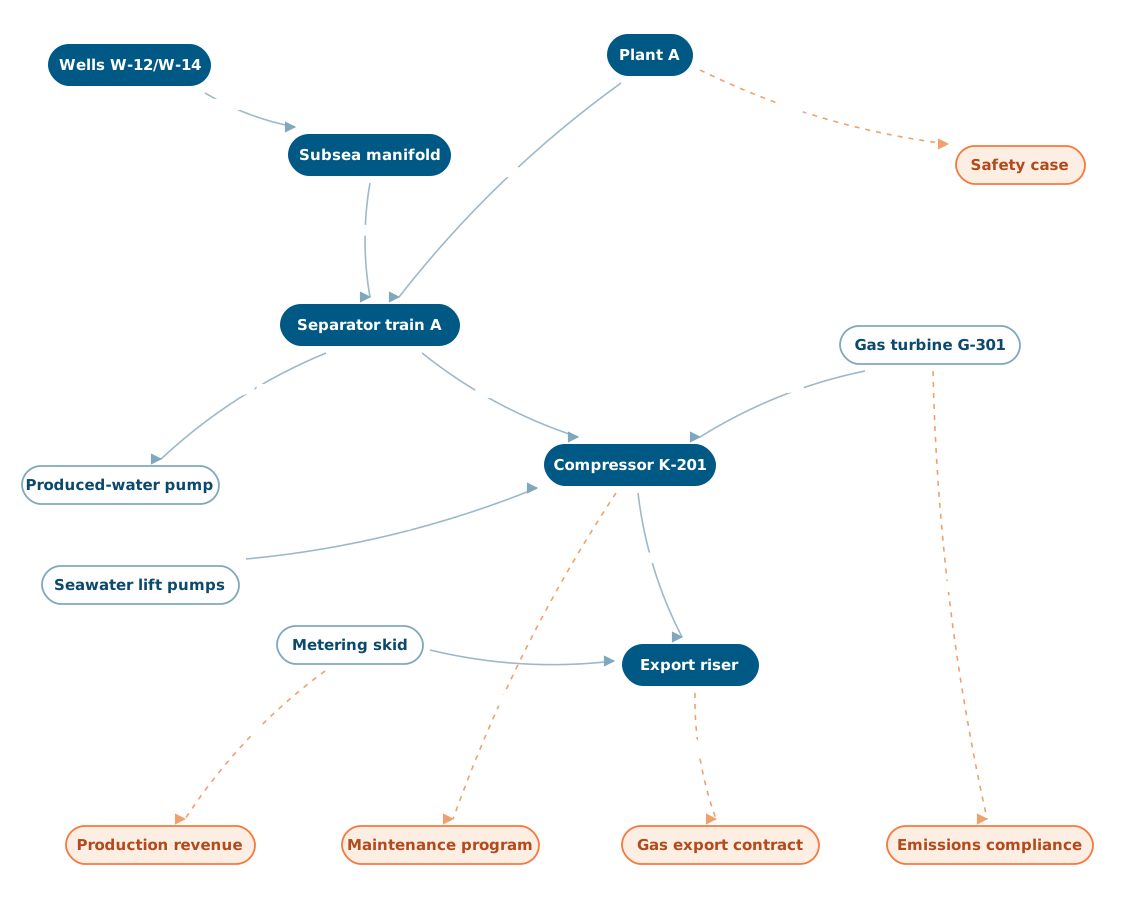
Every claim an agent makes against the graph comes with the path it walked, and, once lineage ships, the ancestry of the values it used. A human can audit the reasoning rather than accepting or rejecting a verdict on faith.
This is what makes agent output usable in a regulated or safety-relevant setting at all. An unverifiable answer is not a cheap answer; it is a liability.
How an agent actually connects
Everything above describes why a model makes an agent better. The plumbing that lets one reach it is short, and deliberately so.
Agents connect through the Model Context Protocol, the open standard for connecting AI assistants to tools, which DataHub serves in two places. The API offers the model itself: equipment and other resources, the relationships between them, time series, events, labels and units, for reading and for writing back. The analysis service offers the relationship analysis behind the console's Analyze tab as a tool of its own, so an agent asked "what is driving this?" answers from statistics rather than estimating. The console's assistant is itself an agent of this kind, a read-only one. Both are part of the standard deployment.
The part worth understanding, even if you never look at the code: agents come in through the same door as everyone else. An agent holds a token like any user or integration, sees exactly what that token may see, and can change exactly what that token may change. There is no separate permission model for agents, and an agent that should only read is given a token that cannot write. How that is controlled →
How to point an assistant at it, and what the tools are for, is on using MCP. The full tool list is in the developer documentation.
An MCP server executes what it is asked. It has no way to stop mid-call and ask a person to confirm a deletion or a write, so if an agent should pause for a human before it changes anything, that gate belongs in the agent you build, not in the platform. The simplest version of this is also the strongest: give an agent that has no business writing a token that cannot write.
Use cases that work today
Grouped by what the agent is actually doing. The pattern to notice: each one turns a signal into a decision somebody can act on, and each depends on context the graph supplies.
Perception, turning signals into meaning
Agents that watch continuous data, fed by subscription so every reading is evaluated as it lands, and emit typed events when something operationally significant happens.
| Agent | Watches | Produces |
|---|---|---|
| Leak detection | Fibre-optic acoustics along a pipeline | A leak located to the metre, long before a survey could reach it |
| Corrosion vision | Inspection drone and camera imagery | Ranked corrosion findings against specific equipment |
| Methane watch | Emissions sensors, cross-checked against satellite passes | A verified emissions figure rather than an estimate |
| Hydrate watch | Subsea temperature and pressure | Early warning that a line is at risk of blocking |
| Kick detection | Drilling telemetry | A well-control alert while there is still time to act |
| Red-zone vision | Deck and plant cameras | A person detected in a lift zone, and the lift held |
The graph's contribution here is calibration. "Unusual" for a pump running a known duty cycle is different from "unusual" for the same pump at start-up, and the agent only knows which situation it is in because the model tells it.
For the full chain drawn out, signals into a detection function, the event waking an agent, the agent's draft going to a person, see from detection to action.
Triage, turning noise into one clear action
A process trip triggers hundreds of alarms at once, and operators cannot see which one matters. An alarm triage agent walks the graph from each alarm to the equipment, the function it serves and what depends on it, collapses the flood into the causal chain, and presents the single action to take, then confirms the plant settles afterwards.
This is the highest-value early agent use case in most operations, because the pain is acute, the benefit is immediate, and it requires no new instrumentation, only a model of what connects to what.
Planning, turning findings into scheduled work
Agents that convert a detection into work that is actually ready to execute:
- A work-order agent turns ranked corrosion findings into draft repair orders.
- A parts agent checks what the repair needs against what is in stock and on order.
- A permit agent drafts the work permit, with the isolations the graph says are required.
- A logistics agent matches the work to a weather window and a vessel schedule.
Each of these is a task where the information exists but assembling it is tedious and error-prone. The agent is not making the maintenance decision; it is removing the two days of coordination between the decision and the work.
Optimisation and control, within stated limits
A setpoint optimiser proposes better operating points from a process model; a control agent applies them within limits a human has set. A dosing agent adjusts chemical treatment so water clears spec before reinjection. An inhibitor agent keeps a subsea line flowing.
This class needs the most care and gives the most back. The guardrail is not that the agent is trusted, it is that the limits are explicit, the actions are logged as events against the equipment, and any setpoint can be traced to the reasoning that produced it.
Reporting and compliance
A reporting agent compiles a verified figure into the regulator's format, ready to file, and once lineage ships, with the ancestry intact, so the submission carries its own evidence. A second agent turns the operational record into the figures finance and the auditors work from.
This is a natural first agent use case for organisations whose pain is reporting rather than operations. The work is well defined, repeats on a cycle, and the accuracy is verifiable against the raw data.
Search and briefing
An operations copilot answers questions from the field archive, documents, procedures, history, and returns sourced answers rather than confident prose, because every claim points at the resource or file it came from.
A briefing agent pulls the risk, operations, commercial and sustainability picture together with live events and briefs leadership in plain terms, the same figures the engineers see, framed for the people accountable for them.
An organisation of agents
One agent is a tool. Several agents, structured, are a capability, and the structure they need turns out to be one every reader already knows.
Coordination
Once several agents run, something has to sequence them. A coordinator fuses the models' outputs, orders the work and holds production in balance, so a dosing change and a maintenance isolation do not arrive at the same operator in the same minute with no sense of which comes first.
The coordinator is the point at which a collection of clever tools becomes an operating capability. It is also the point at which the model has to be right, because the coordinator reasons entirely over relationships.
Scale this up and the shape becomes familiar: it is an organisation chart. Worker agents do the tasks, running integrations, drafting the reports, flagging faults, watching data quality. Manager agents own a domain each: they break down what the coordinator hands them, check the work, and tune their workers' incentives. One coordinator agent holds the whole against the goals leadership set. The reporting lines are prompts and scores rather than meetings, but the shape exists for the reasons human organisations discovered long ago: span of control, separation of concerns, and accountability at every level.
None of this is a product feature you switch on. The agents run outside the platform, built on whichever framework you prefer, and the chart is an architecture pattern, not a module. What the platform contributes is the two things no agent framework brings with it: the shared model of the operation that lets a hundred agents mean the same thing by "pump P-101", and the event log every action and outcome is recorded against.
Where this is heading: dynamic incentives
Once several agents run continuously, a management question appears that single-task agents never raise: how do you steer them over time? Rewriting instructions per agent does not scale. The direction the field is moving is to steer with incentives: score the outcomes of an agent's work, feed the score back, and let the agent weight its own priorities by what actually helped.
The signals are the ones you would use for a person, observed rather than asserted:
- A warning that an operator acted on, against one that was dismissed
- A drafted work order accepted as written, against one rewritten from scratch
- A prediction confirmed by the outcome, against one that quietly expired
- A falling false-alarm rate, weighted more heavily than a rising detection count
A triage agent steered this way learns to stop surfacing the alerts nobody acts on. A work-order agent learns which drafting style planners accept. The feedback loop becomes the management tool, which is exactly how you already manage people, made continuous.
Two things make this workable rather than reckless. First, the loop runs through the event log: an outcome can only be attributed to an agent's action if both were recorded against the same resources, so the platform's record of actions and outcomes is the substrate incentives are computed from. Second, incentive design needs the same care as human KPIs, and fails the same way: reward the measure and you get the measure, not the goal (Goodhart's law). Keep humans owning the incentive definitions, keep them few, and audit what behaviour they actually produce.
The workforce will not stay virtual
Everything above describes software reasoning about information. The same shift is now arriving in hardware: humanoid robots and androids are moving from demonstrations towards deployment, inspection robots and drones already walk and fly industrial sites, and offshore, normally unmanned installations operate today with no permanent crew. The direction for oil and gas is platforms designed from the first drawing to run unmanned, visited a few times a year.
An unmanned facility is operated through its digital twin: when nobody is on board, the model is the only place the operation is visible, and every decision, human or machine, is made against it. And notice that the organisation chart above does not change when a worker grows a body. The fault-watch agent that flags a failing seal and the inspection robot that walks to the flange to confirm it are colleagues in the same structure, coordinated the same way, reasoning over the same graph. If anything, the embodied worker needs the model more: a robot that does not know which pipe it is looking at is a camera on legs, and knowing which pipe is exactly what contextualization puts into the model.
For a board, this reframes the timing question. The unmanned facility is no longer science fiction, it is an engineering programme with published precedents, and the gating asset is not the robot, it is an operation described well enough for machines to work in it. That description is built the same way whether the workforce it serves is software, humans or steel, which is why starting it now is the low-regret move. Why this becomes a requirement →
Agents that build and run your integrations
A distinct and underrated use case: agents are very good at writing and operating the integrations that feed DataHub.
Integration work is the single biggest driver of how long a first project takes (where to start), and most of it is not intellectually hard, it is laborious, repetitive, and needs patience with other people's data models. That profile suits an agent well.
What an agent can do here
Read a source database's structure, sample its contents, and work out what each table actually holds, the job that normally requires vendor training or a week of guessing.
Which rows become resources, which columns become time series with which unit and value type, which changes become events, and what the stable external id should be. Because the target model already exists in the graph, the agent has something concrete to map onto rather than inventing a schema.
Generate the code against the platform's documented API, in whichever language your team maintains.
Watch the integration in production, notice when a source system changes shape, diagnose what broke, and propose the fix, the part of integration work that is genuinely open-ended and usually gets neglected until something is badly wrong.
Why it works better here than elsewhere
Two properties of the platform make agent-written integrations unusually tractable:
- The target vocabulary is tiny. Everything reduces to four building blocks. An agent mapping onto four primitives makes far fewer mistakes than one mapping onto a five-hundred-table enterprise schema. The four building blocks →
- The API is documented and stable, and the model is inspectable. The agent can read the existing graph to see how comparable equipment was already modelled, and follow the same conventions rather than inventing new ones.
The guardrails that matter
An agent writing integrations is writing something that will run unattended against your operational data. Treat it accordingly:
- Review the mapping, not just the code. A syntactically perfect integration with the wrong external id convention is far more damaging than one that fails to compile, because it succeeds quietly and cannot be undone.
- Give it a narrow service account. Write on the specific data sets it feeds, no read, and read-only credentials on the source. Service accounts →
- Land a small pass first. A few hundred rows, inspected in the console, before the remaining hundreds of thousands.
- Keep a human accountable for the conventions. The data steward still owns naming and data set boundaries. Who does what →
What agents do not remove
Being clear about this protects the credibility of everything above.
| Agents do not remove | Why |
|---|---|
| The need for the model | Everything on this page is downstream of somebody saying what the things in your operation are. Agents make the model more valuable; they do not substitute for it. |
| Domain judgement | An agent narrows the field and assembles the evidence. Deciding what it means, in a plant you are accountable for, remains a human job. |
| Accountability | A drafted permit is drafted. A proposed setpoint is proposed. Approval stays where it already sits. |
| Data quality problems | An agent reasoning over gap-filled data reaches gap-filled conclusions. It can at least see the quality flags, but only if lineage exists. |
Where to start with agents
Every agent use case above assumes the graph. Without it you are back to pattern-matching on unlabelled numbers. Building your model →
Reporting, search, triage suggestions. Not control. The first agent should be one whose errors are visible and harmless while you learn to judge its output.
Every agent claim should point at the resources, events and values behind it. Anything that cannot be traced should not be acted on.
This is often the fastest payback, because integration effort is the main thing standing between you and the second question.
Control, dosing, scheduling, with explicit limits, logged actions, and a human accountable.
Why this ends up being a requirement, not an option
Worth stating plainly, because it is the strategic case rather than the operational one.
Agent capability is multiplied by the quality of the context available to it, not added to it. Two competitors adopting the same tools do not get the same result: the one with a model gets an agent that can follow a problem through the operation and show its working, and the one without gets output that a person has to re-check. Same tools, different multiplier.
That difference compounds, because each answered question makes the next cheaper. And the input that drives it, a model of your own operation, is the one thing that cannot be bought at short notice: it takes calendar time and the attention of people who know the plant.
Which is why waiting is weaker here than it usually is. Adopting later does not shorten the work, it only starts it later. The full argument →
The honest framing is that AI capability is downstream of the data model, not an alternative to building one. Organisations that skip the model get demonstrations; organisations that build it get compounding capability, because every agent they add inherits the same context. That ordering is the whole strategic argument. Board briefing →
- Using MCP: the protocol, the 38 tools an agent connects through, and how to connect one
- Building AI agents: what to build, the limits to set, and worked examples by industry
- What is machine learning?: regression, clustering and neural networks, explained without maths
- Knowledge graphs: the structure agents reason over
- Lineage and data quality: what makes agent output checkable
- The operational data problem: why context, not algorithms, is the blocker
- Change data capture: the integration work agents can take on
- Where to start: sequencing a first project